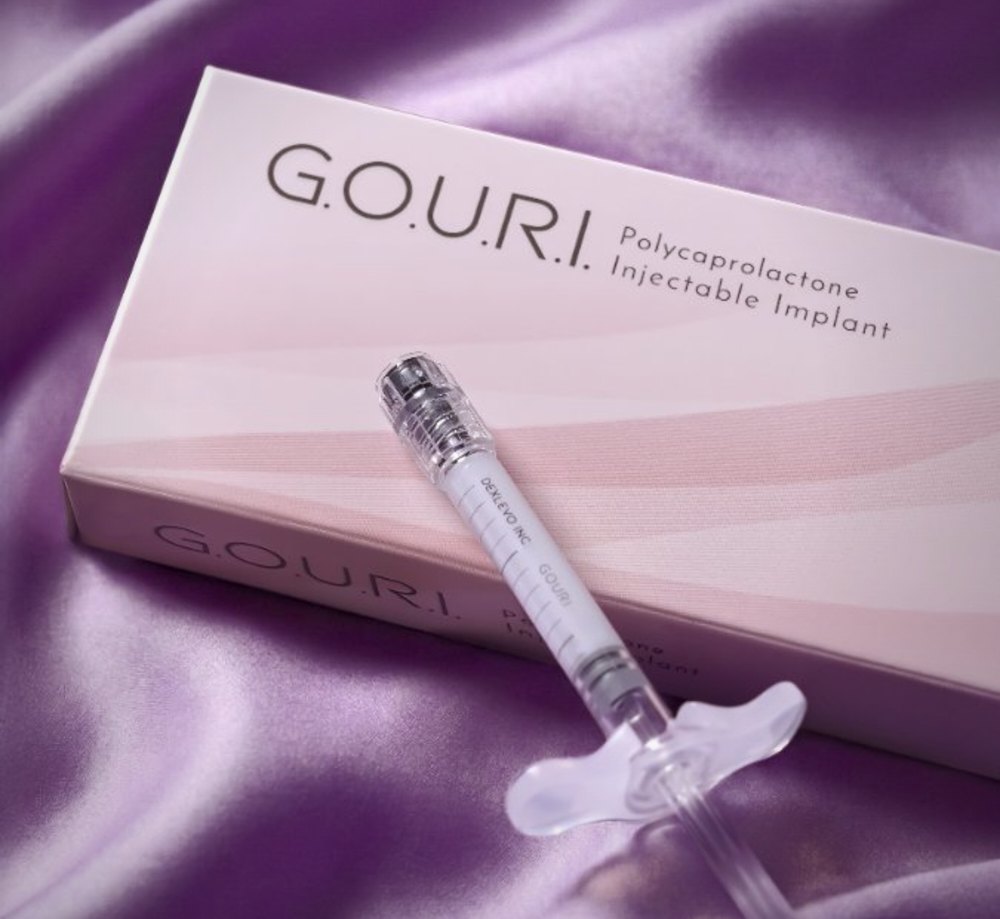
Watching the aesthetic dermatology market these days, I'm struck by how fast it changes. As the market grows, products vying to lead the trend keep appearing on the strength of their technology, and whenever a new one comes out I study it carefully and try it myself before judging. GOURI is one of the products I chose that way.
But when I introduce GOURI, nine out of ten people ask the same question: "How is it different from that famous product?"
It starts with the same ingredient: PCL
Both use an ingredient called **PCL (polycaprolactone)**. It is a long-proven ingredient, used even in medical sutures, that breaks down gradually in the body. PCL stimulates the collagen-producing cells in the skin, so your skin makes its own collagen to fill hollow areas. Up to this point, they are the same.
The difference starts with 'form'
Competing products with nodule issues turn PCL into tiny beads, i.e. particles. They work well, but there have long been reports that these particles can clump together under the skin and form hard nodules. That is why so many people, despite knowing the results, have put off treatment "because they're afraid of nodules."
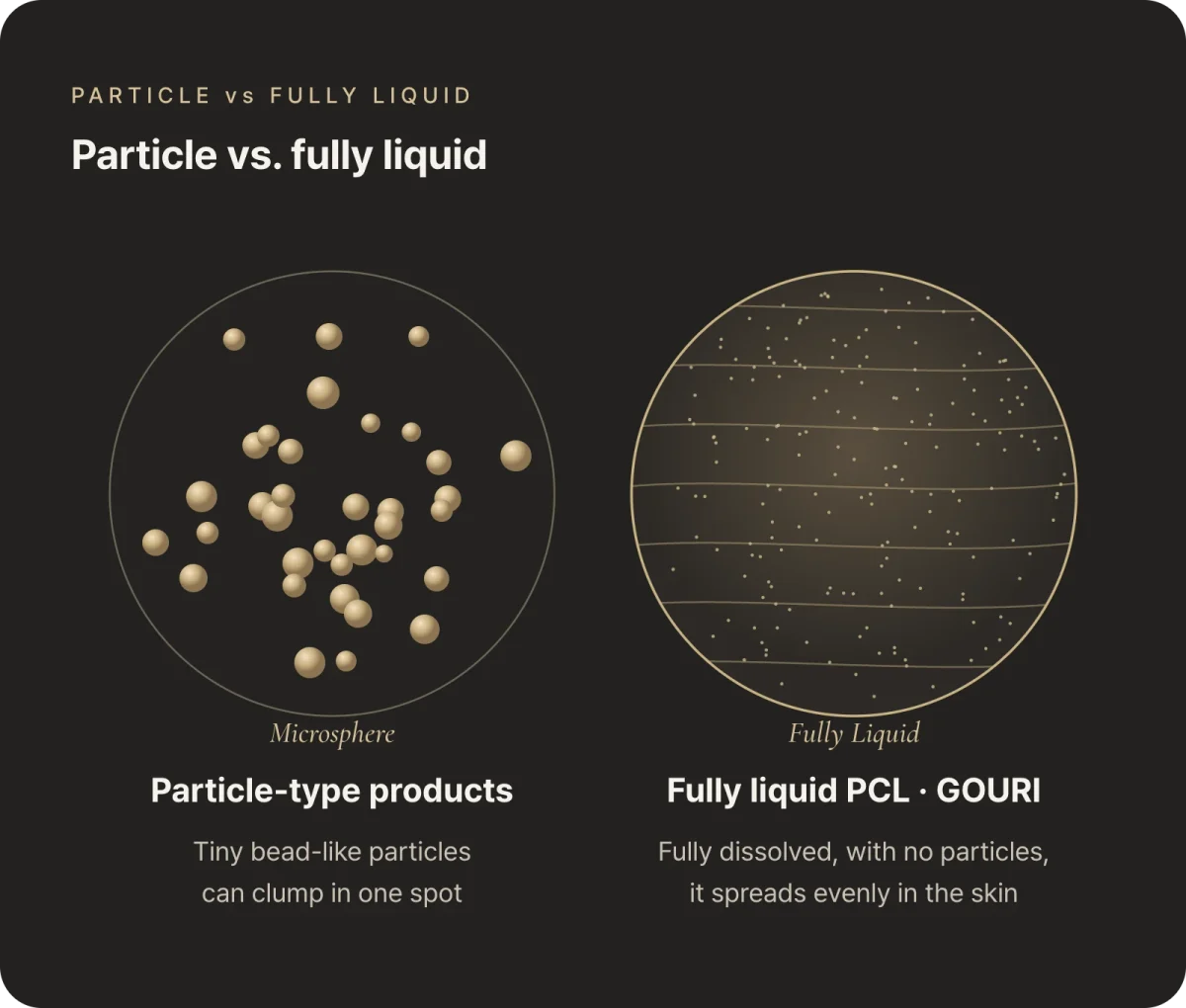
The particle type contains granules that can clump; the fully liquid type has no granules at all.
GOURI has fully liquefied the same PCL. It turns PCL — which normally doesn't dissolve easily — into a uniform liquid with no particles. It sounds simple, but in practice it requires advanced technology. With no granules, there is nothing to clump, and once injected it spreads thinly and evenly within the skin.
So it is safer — considerably so
Because the very 'clumping' that caused nodules has been structurally reduced, there is a clear difference in safety. Evenly dispersed PCL builds collagen naturally across a wide area, so there is less worry about lumpiness or hardness. And if needed, repeat treatments can follow comfortably.
That said, I never rely on the product alone and inject carelessly. At what depth, how much and at what spacing — these are still decisions the practitioner must make precisely. The better the product, the more delicately I try to handle it.
Six months after treatment: time for collagen to build
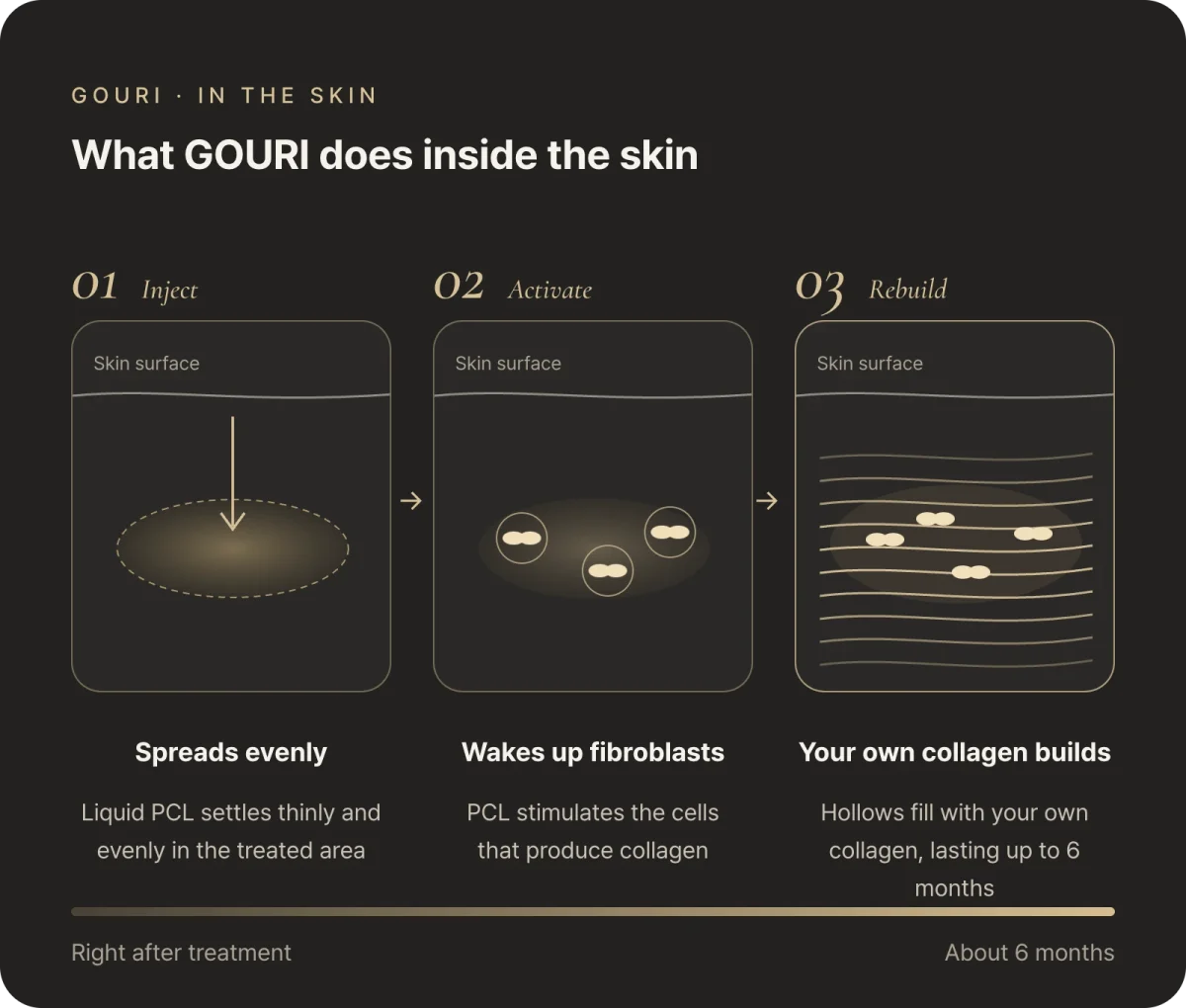
Injection → fibroblast activation → formation of your own collagen. This process continues for about six months.
GOURI is not a product whose work ends with the injection. The PCL settled in the skin continuously stimulates collagen production, so over time the skin fills in and firms up from within. The effect continues for up to about six months, so you can expect natural, long-lasting change.
In your 30s? 2–3 sessions, 2 syringes each
I especially recommend GOURI for people in their 30s. Around this age, the cheeks and temples begin to hollow gradually and shadows start to appear along the facial contours. The skin still produces collagen well at this stage, so it responds nicely. Typically, 2–3 sessions of 2 syringes each clearly soften hollow, sunken contours.
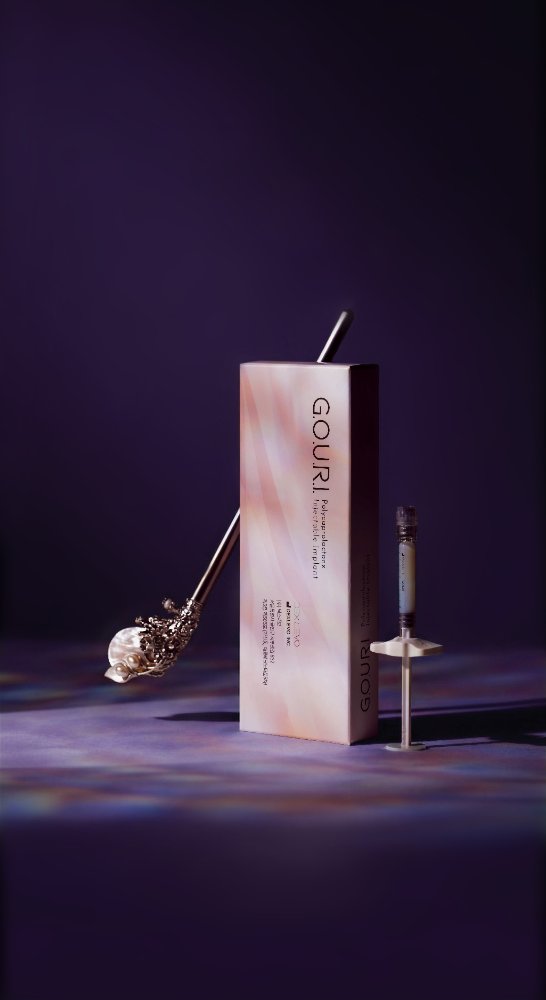
GOURI · Fully liquid PCL
With the same ingredient, a different technology makes a different product; with the same product, different hands produce different results. On top of GOURI's excellent technology, I will complete that difference with precise treatment.
If you've been holding off because of nodules, now is a good time to start with GOURI.